How to Clean and Descale Your Espresso Machine
Espresso machines don’t usually “break” suddenly. They get slowly worse: bitter shots from coffee oil build‑up, weak steam from a clogged tip, or low flow from scale forming inside the boiler and valves. The fix is not an occasional deep clean — it’s a simple repeatable routine. This guide shows what to clean daily and weekly, when (and when not) to descale, and how to do both safely without guessing.
Quick Picks: Cleaning & Descaling Checklist
Use this page like a maintenance checklist. Most performance problems are solved by the first three sections.
-
Fast Answer: the safe routine in 60 seconds
↓ Jump to Section -
Expert Sources: manufacturer + pro cleaning guides
↓ Jump to Section -
Daily & Weekly Cleaning: prevent rancid oils and milk residue
↓ Jump to Section -
Backflush: how to clean the brew circuit (if supported)
↓ Jump to Section -
Descale: when to do it, how to do it safely
↓ Jump to Section -
One Budget Kit: cleaning powder + descaler in one buy
↓ Jump to Section
Fast Answer (What to Do and When)
If you do nothing else, do this:
- After every session: knock out the puck, rinse the basket and portafilter, flush the group for 2–3 seconds, and wipe the shower screen area.
- After steaming milk: wipe the steam wand immediately, purge steam for 1–2 seconds, and purge again after wiping.
- Weekly: soak baskets and metal portafilter spouts in espresso detergent, scrub the shower screen, and wash the drip tray + water tank with mild soap.
- Monthly (or when prompted): run a detergent backflush only if your machine supports it.
- Descale: only when needed based on your water and your manufacturer’s guidance. Over‑descaling can cause issues on some machines.
If you’re constantly descaling, your long-term fix is better water (hardness control), not stronger chemicals. See our water guide here: Best Water for Espresso Machines.
Expert Sources (Manufacturer + Pro Guides)
- La Marzocco Home: how to clean an espresso machine (and why over-descaling can be harmful)
- Breville: step-by-step espresso machine cleaning guide
- Breville: how to run a descale cycle (example: Barista Express)
- Urnex: espresso machine cleaning routine (PDF guide)
- Urnex: how to backflush with Cafiza
- Urnex: Dezcal descaling instructions (mix ratios + safety notes)
Cleaning vs Descaling (Don’t Mix These Up)
Most beginners think “descale” means “clean the machine.” It doesn’t.
- Cleaning removes coffee oils and residue from the brew path (group head, shower screen, solenoid valve, three-way valve, portafilter, baskets). Old oils taste bitter and can clog valves.
- Descaling removes mineral deposits (limescale) from the boiler, thermoblock, and internal water paths. Scale reduces heat transfer, restricts flow, and can trigger pump noise or temperature issues.
You usually need cleaning more often than descaling. A clean brew path keeps flavor consistent. Good water reduces how often you ever need to descale.
What You Need (Minimal, Not Fancy)
- Microfiber cloth (one for the steam wand, one for the rest).
- Group brush or small nylon brush for the shower screen area.
- Espresso detergent (for soaking baskets + backflushing where supported).
- Descaler (citric-acid based products are common; follow your manual).
- Blind basket / cleaning disk (only for machines that allow backflushing).
Avoid abrasive pads on polished metal and avoid strong “DIY chemistry” unless your manufacturer explicitly allows it.
Daily & Weekly Cleaning Routine (Home-Friendly)
After every espresso session (2 minutes)
- Knock out the puck and rinse the basket under hot water.
- Flush the group for 2–3 seconds to rinse the shower screen and clear loose grounds.
- Wipe the group area (around the gasket and shower screen) with a damp cloth or brush.
- Rinse the portafilter and lock it back in (helps keep it warm and clean).
After steaming milk (always, immediately)
Milk bakes onto hot stainless steel fast. If you wait, you’ll eventually get a clogged steam tip and sour smells.
- Purge before wiping: open steam for 1 second to blow out condensation.
- Wipe the wand: use a damp microfiber cloth (not a dry towel).
- Purge again: 1–2 seconds to clear milk drawn into the tip.
Weekly (15–25 minutes)
- Soak baskets and metal parts: place baskets and metal portafilter spouts in hot water + espresso detergent. Don’t soak wooden/plastic handles.
- Scrub the shower screen: brush around the gasket and screen. If your screen is removable, take it off and rinse it thoroughly.
- Clean the drip tray and reservoir: warm water + mild dish soap, then air dry.
- Steam tip check: if the tip is removable, take it off, rinse, and check that all holes are clear.
Backflushing (Only If Your Machine Supports It)
Backflushing pushes water (or water + detergent) backwards through the group head to clean valves and passages that normal rinsing can’t reach. This is typically used on machines with a three-way solenoid valve and a compatible brew design. If your manual does not mention backflushing, assume your machine is not designed for it.
Water backflush (quick rinse)
- Insert a blind basket (or cleaning disk) into your portafilter.
- Lock in the portafilter and run the pump for 5–10 seconds.
- Stop. Let pressure release. Repeat 3–5 times.
- Remove the portafilter and rinse.
Detergent backflush (deep clean, monthly)
Use a small amount of espresso machine detergent (follow the detergent’s instructions and your manual). Urnex provides a standard backflush procedure for Cafiza, which is widely used in cafés.
- Add detergent to the blind basket, lock in the portafilter.
- Run the pump 10 seconds, stop 10 seconds. Repeat 5 times.
- Remove and rinse the portafilter, then repeat the same cycle with clean water to flush the system.
- Pull and discard one “seasoning” shot after cleaning (optional but helpful for taste).
How to Descale Safely (Step-by-Step)
Descaling is not a weekly ritual. It is a response to your water conditions and your machine’s design. Some manufacturers explicitly caution against frequent descaling because strong acids can stress internal components. Before you start: read your machine’s manual. If it has a descale program, use it.
When should you descale?
- Your machine prompts you (descale light / service reminder).
- Steam pressure dropped and the steam tip is already clean.
- Hot water flow is weak or the machine sounds unusually loud during heating.
- You see scale in the tank, on fittings, or flakes in hot water output.
If you’re troubleshooting “bad shots,” note that scale is only one possible cause. If your espresso is suddenly sour or bitter, it’s often grind or puck prep — see: Troubleshooting Espresso Machine Problems.
General descale process (tank machines)
This is a safe, generic outline. Your machine may differ (especially dual boilers, E61 machines, or machines that discourage user descaling).
- Remove any water filter from the tank (filters can be damaged by descaler).
- Mix descaler correctly in warm water (follow your product label). Never pour dry powder directly onto internal parts.
- Fill the reservoir with the solution and place a large container under the group head and hot water outlet.
- Run solution through the brew circuit (and hot water circuit if your machine has it). Many machines recommend pulsing rather than draining the whole tank at once.
- Soak time: let the solution sit briefly (follow product and manufacturer timing). Avoid “overnight soaks” unless specifically instructed.
- Flush thoroughly: run at least 2 full tanks of clean water through all circuits until there is no odor or taste of descaler.
What not to do
- Don’t use vinegar by default. It can leave odor/taste and may be discouraged by many manufacturers.
- Don’t descale too often. If you need monthly descaling, your water plan is the real problem.
- Don’t ignore flushing. Incomplete rinsing can ruin taste and irritate sensitive parts over time.
- Don’t mix products. Never combine detergent and descaler, and don’t mix brands unless directed.
How Often Should You Clean and Descale?
Frequency depends on usage and water hardness. Use this as a low-risk starting schedule:
- Daily: rinse portafilter/basket, flush group, wipe + purge steam wand.
- Weekly: soak baskets/spouts, clean drip tray + reservoir, scrub shower screen.
- Monthly: detergent backflush (if supported); deep steam wand tip clean if you make milk drinks often.
- Descale: every 2–6 months only if your water requires it, or when the machine prompts you.
If you’re unsure about your water, test strips are cheap and take 30 seconds. The goal is not “pure” water. The goal is water that tastes good and does not aggressively scale your boiler.
One Budget Buy That Covers the Essentials
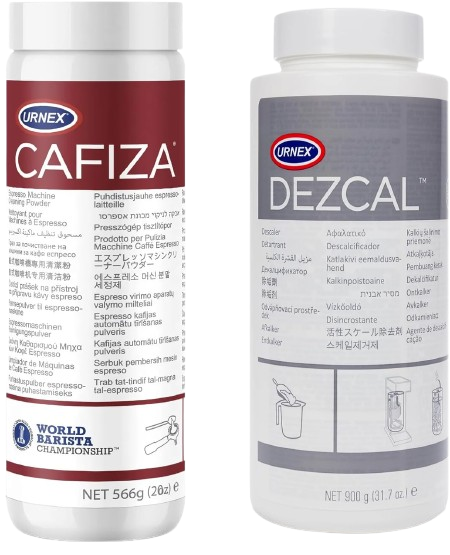
If you want a single purchase that handles the two big problems (coffee oils + scale), a combo kit is the simplest option. This one covers both: detergent for baskets/backflush and a descaler for internal mineral build-up.
FAQ
Do all espresso machines need backflushing?
No. Backflushing is a specific cleaning method for machines designed for it (commonly with a three-way solenoid). If your manual doesn’t mention a blind basket or backflush routine, don’t improvise.
Why does my espresso taste worse even though the machine is “clean”?
“Clean” usually means “no visible mess.” Flavor problems are often caused by old coffee oils in the group/portafilter, stale beans, or grind changes. If shots suddenly run faster/slower, check grind and dose first.
Is descaling safe for every machine?
Follow your manufacturer. Some machines recommend descaling through a program, some recommend professional service, and some focus on prevention (good water) rather than aggressive acid cleaning. When in doubt, use the manual as your source of truth.
Bottom Line
Your espresso machine will reward small routine habits more than occasional “big cleans.” Clean coffee oils often, treat milk residue as urgent, and descale only when your water and manufacturer guidance justify it. If descaling feels frequent, solve the root cause with better water — your machine (and your espresso) will last longer.