Best Water for Espresso Machines: Hardness, Filtration & Scale Prevention
If your espresso tastes inconsistent, your machine scales up too quickly, or you’re trapped in “descale alerts forever,” water is a likely culprit. Good espresso water is not “pure water.” It’s clean water with the right mineral balance — enough to extract flavor, but not so much that it creates scale and clogging. This guide gives you a simple plan you can actually follow at home.
Quick Picks: Best Water Strategy (Read This First)
Use the fast answer for an immediate plan, then jump to the section that matches your water situation.
-
Fast Answer: the safest “good enough” water plan in 60 seconds
↓ Jump to Section -
Expert Sources: standards and guides worth trusting
↓ Jump to Section -
Target Numbers: hardness, alkalinity, chloride — what to aim for
↓ Jump to Section -
Test Your Water: fast methods that don’t require a lab
↓ Jump to Section -
Choose a Treatment: pitcher vs in-tank softener vs remineralized water
↓ Jump to Section -
Budget “Set-and-Forget” Option: one product that makes safe espresso water
↓ Jump to Section
Fast Answer: What Water Should I Use?
If you want the shortest, lowest-risk answer: use water that is odor-free (no chlorine taste), has moderate minerals, and low scale risk. For most home users, the easiest reliable plan is:
- If your tap water is already fairly soft: use a carbon filter (pitcher or under-sink) mainly to remove chlorine/odor, then keep an eye on scale over time.
- If your tap water is moderately hard: use carbon filtration for taste plus an espresso-focused softening solution (often in-tank ion exchange) to reduce scale.
- If your tap water is very hard: stop fighting it. Use distilled/RO water and remineralize it with a coffee water recipe or mineral packets.
One warning that saves machines: do not run straight distilled or straight RO water long-term. Ultra-pure water can taste flat and can be more aggressive to metals and internal components in some systems. If you’re using distilled/RO, add minerals back in a controlled way (see the product option and DIY notes below).
Expert Sources (Standards + Practical Guides)
Water is confusing because people talk about “TDS” like it’s everything. It isn’t. The most reliable way to stay sane is to anchor on standards (hardness/alkalinity) and use a repeatable treatment approach. These sources are the best starting points:
- James Hoffmann: The Best Water for Coffee (intro video)
- Lance Hedrick — Ultimate Guide to Water for Coffee (deep dive video)
- SCAE Water Chart (Wellinger, Smrke, Yeretzian): PDF
- SCAA Water Standards (targets + acceptable ranges): PDF mirror
- La Marzocco: Water for Home Espresso Machines
- Barista Hustle: DIY Water Recipes (The World in Two Bottles)
Target Numbers That Actually Matter
You don’t need perfect water. You need to avoid extremes. Two numbers drive almost every espresso water problem: hardness and alkalinity. Hardness is your scale risk. Alkalinity is your taste buffer (and a hidden cause of “why does everything taste harsh or dull?”).
1) Hardness (scale risk)
Hardness is mostly calcium and magnesium expressed as ppm (mg/L) as CaCO3. Higher hardness increases scale formation in boilers, thermoblocks, and valves. A common target range in coffee standards is roughly 50–175 ppm as CaCO3, with many espresso setups happiest toward the lower-middle of that band.
2) Alkalinity (taste buffer)
Alkalinity is water’s ability to neutralize acids. In coffee, it changes how bright or muted the cup tastes. Too high and espresso can taste flat, chalky, or “dead.” Too low and shots can feel aggressively sharp and unstable. Many coffee standards aim near ~40 ppm as CaCO3 (with a practical acceptable range often extending higher).
3) Chlorine and chlorides (taste + corrosion risk)
Chlorine ruins flavor quickly — carbon filtration is often enough to remove it. Chloride (a different thing) is more about corrosion risk in some machines. Don’t obsess over one number, but treat “very salty” mineral waters and high-chloride supplies as a red flag.
4) TDS (useful, but not a decision by itself)
TDS is a rough total of dissolved minerals. It can help you spot extremes, but it doesn’t tell you whether those minerals are the ones you want. Two waters can share the same TDS and behave very differently if one is mostly bicarbonate and the other is mostly calcium.
How to Test Your Water (Fast, Cheap, Good Enough)
You don’t need a lab report to make a good decision. You need a reasonable estimate of hardness and alkalinity. Here’s a practical testing order that works for most people:
Step 1: Check your local water report (if available)
Many cities publish annual water quality reports. Look for terms like hardness, alkalinity, chloride, and sometimes TDS. Reports are a baseline, not a guarantee, but they tell you whether you’re fighting a hard-water city or not.
Step 2: Use GH/KH drop tests (best value)
Aquarium-style drop tests (GH = general hardness, KH = carbonate hardness/alkalinity) are surprisingly useful for espresso. They give you numbers you can act on, and they let you measure filtered water too — which is what actually matters.
Step 3: Use a TDS meter as a “sanity check”
A cheap TDS meter won’t tell you the full story, but it can confirm whether you are in the “very low minerals” or “mineral soup” zone. Use it to catch extremes and track filter changes over time, not to declare a water “perfect”.
Choose the Right Water Strategy (Decision Tree)
The right approach depends on one thing: how hard your input water is. Here’s the simplest decision tree that avoids most mistakes:
- Soft-ish water (low scale risk): carbon filter for taste (chlorine removal). Re-test occasionally and watch for scale signs.
- Moderate hardness: carbon filter + softening (in-tank ion exchange or a cartridge designed for espresso) to reduce scale.
- Hard water (frequent descaling or visible scale): switch to remineralized distilled/RO so you control minerals instead of reacting to problems.
Pitcher filters (what they do well, what they don’t)
Pitcher filters are great at improving taste by reducing chlorine and odors. But many “Brita-style” filters are not guaranteed scale solutions for genuinely hard water. If you want to know whether your pitcher is doing enough, test hardness before and after. If hardness barely moves, your machine will still scale — just with slightly better-tasting water.
In-tank softeners and ion exchange (scale-focused)
Many espresso machines accept small in-tank resin filters. These typically reduce hardness by swapping calcium/magnesium ions for other ions. The benefit is simple: lower hardness = lower scale formation. The downside is capacity: if your water is very hard, these filters can saturate quickly and become ineffective unless you replace them often.
RO or distilled + remineralization (the consistency-first approach)
If your tap water is hard, this is often the most practical “set a system and stop thinking” solution. You start with low-mineral water (distilled or RO) and add minerals back to hit a sensible range. The result is consistent espresso and dramatically lower scale risk — without relying on unknown tap fluctuations.
What About Bottled Water?
Bottled water is not automatically safe. Some brands are too hard and scale machines quickly; others are so soft that espresso tastes thin. If you use bottled water, treat it like tap water: check the mineral label (or test it) and avoid extremes.
- Green flag: moderate minerals and no strong taste/smell.
- Red flag: very high calcium/magnesium, “very mineral” taste, or high chloride/sodium waters marketed as electrolyte-heavy.
Daily Habits That Reduce Scale Without Ruining Espresso
Even with good water, your habits matter. The goal is to avoid scale buildup so you don’t need aggressive descaling cycles. The best long-term strategy is: prevent scale and keep the machine clean.
- Don’t descale on a panic schedule: descaling chemicals are not “free.” Over-descaling can be hard on machines. Prevention beats constant acid cycles.
- Replace filters by capacity: calendar schedules are rough guesses; hardness and usage change the real lifespan.
- Watch early scale signals: slower flow, weaker steam, more pump noise, longer heat-up times, and “mystery” taste drift.
- Be consistent: changing water sources every week makes dialing in harder and makes taste comparisons meaningless.
Recommended “Set-and-Forget” Option (1 Budget Buy)
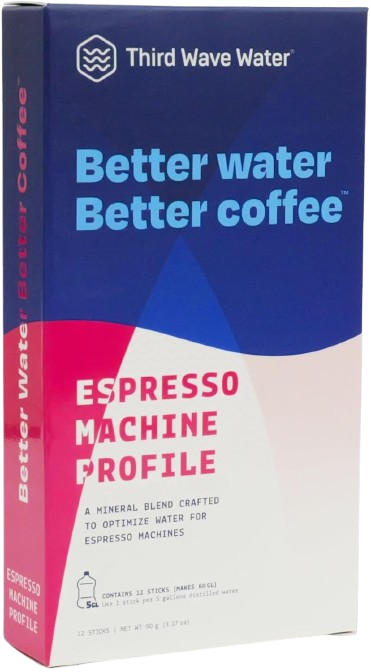
If your tap water is hard or unpredictable, the easiest path to consistent espresso water is distilled water + mineral packets. You mix once, then refill your tank with the same water every time — stable taste, lower scale risk, and less guesswork.
FAQ
Can I use distilled water in my espresso machine?
Distilled water by itself is usually not ideal long-term. It has almost no minerals, which can make espresso taste flat and can be harsh for some machine materials. If you want the low-scale benefits of distilled/RO water, the safer approach is to remineralize it with a known recipe or mineral packets.
Is a pitcher filter enough to prevent scale?
Sometimes, but only if your water is already in a reasonable hardness range. Pitchers are excellent for chlorine taste and odor. For truly hard water, you usually need a scale-focused softener (ion exchange) or a remineralized distilled/RO approach. The quickest way to know is to test hardness before and after filtering.
What matters more: hardness or alkalinity?
Hardness is the scale driver. Alkalinity is the flavor buffer. In practice, both matter — but alkalinity often explains “harsh vs muted” taste problems that people blame on grinders or recipes. If you can only test one thing, alkalinity is frequently the missing piece for taste.
How do I know scale is starting to build up?
Scale problems are usually gradual: slower water flow, declining steam power, louder pump sounds, and longer heat-up times. If those patterns appear and your water is hard, scale is a strong suspect.
How often should I change filters or softeners?
Follow the manufacturer’s capacity guidance, then adjust based on hardness and how much water you run through the machine. If you can, re-test filtered water occasionally — it’s the most honest way to confirm you’re still in a safe range.
Bottom Line
The best water for espresso machines is not “pure” — it’s balanced. Aim for moderate hardness, reasonable alkalinity, and zero chlorine taste. If your tap water is hard, don’t fight it: use remineralized distilled/RO water so you control minerals and stop chasing scale. Once water is stable, dialing in and machine maintenance become dramatically easier.